Mandatory B2B e-invoicing in Spain: the dates are now official
Order HAC/1028/2026 has started the clock on mandatory B2B e-invoicing in Spain: 6 October 2027 for large companies and 2028 for everyone else. What to do now.
Equipo Cesko DesignAuthor
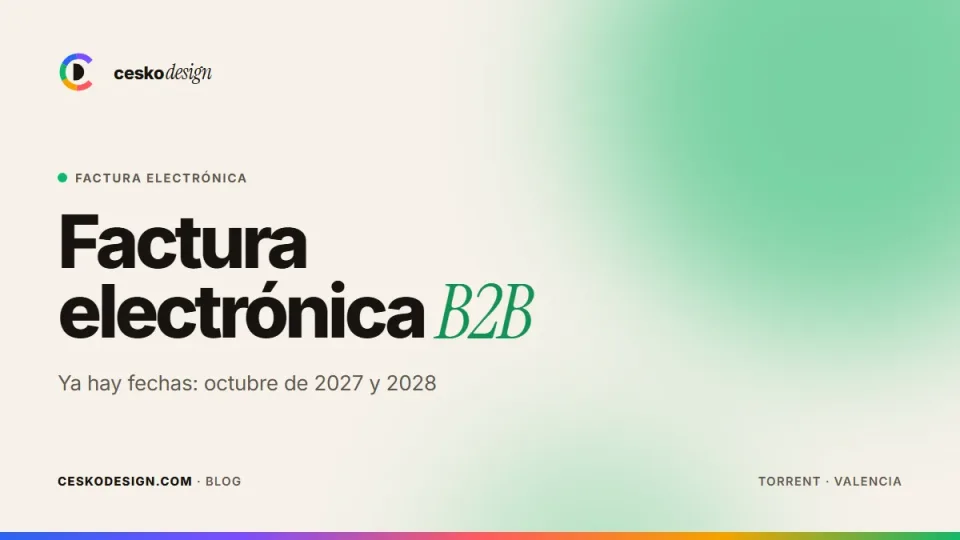
Mandatory electronic invoicing between businesses and professionals in Spain now has dates: 6 October 2027 for those invoicing more than 8 million euros a year and 6 October 2028 for everyone else (that is, almost all SMEs and the self-employed). The clock started on 6 October 2026 with the entry into force of Order HAC/1028/2026, which regulates the public invoicing solution. Here is what changes, who it affects and what you can do this year so it does not catch you at the last minute.
Where the obligation comes from
Law 18/2022 on the creation and growth of companies (the "Crea y Crece" Law) imposed, in its article 12, electronic invoicing for all transactions between businesses and professionals, with a stated goal: reducing late payment and giving traceability to payments. The regulation was missing, and it took a while: Royal Decree 238/2026, of 25 March, published in the BOE on 31 March 2026, developed it, as reported by the Spanish Tax Agency. But the regulation tied the deadlines to a later ministerial order, the one regulating the public platform.
Order HAC/1028/2026: the starting gun
That order is Order HAC/1028/2026, of 2 October, published in the BOE on 5 October 2026 and in force since 6 October. According to the Tax Agency's notice, the deadlines count from that date:
- By 6 October 2027 (12 months): businesses and professionals with a turnover above 8 million euros must issue, send and receive electronic invoices, and report invoice and payment statuses.
- By 6 October 2028 (24 months): all other businesses and professionals must issue, send and receive electronic invoices. Legal entities (companies) with turnover equal to or below 8 million must also report invoice and payment statuses from then on.
- By 6 October 2029: natural persons (the self-employed) and entities under the income attribution regime get one more year for the obligation to report invoice and payment statuses.
What changes in practice
An electronic invoice is not a PDF by email
An electronic invoice, in the sense of this rule, is a structured file (formats such as Facturae, UBL or CII) that the recipient's software can read automatically. The PDF you email today stops being valid between businesses. Invoices to private consumers do not change.
Two routes: the public solution or private platforms
The Spanish system has a public electronic invoicing solution (free, run by the Tax Agency) and allows the use of private platforms, which must be interconnected with each other and with the public one free of charge, according to the order itself. For an SME, the usual route will be for its invoicing software or its accountant to connect to one of them; for a self-employed person with few invoices, the public solution may be enough.
Invoice and payment statuses
The real novelty against late payment: the recipient will have to report whether it accepts or rejects the invoice and when it pays it, within the deadlines set by the regulation. That makes visible who pays late. When the invoice is already issued as paid (for example, cash or advance payment), the payment status information is deemed fulfilled.
How to prepare in 2026-2027 without stress
- Find out which bracket you are in. If you invoice less than 8 million (the vast majority), your date is 6 October 2028. Write it down.
- Ask your invoicing software or your accountant whether they will support structured e-invoices and statuses, and by when. If the answer is vague, start looking at alternatives in good time.
- Combine it with Verifactu. The same software will have to comply with the invoicing systems regulation (Verifactu) and with B2B e-invoicing. Change software once, not twice.
- Review your master data. Correct tax ID, company name and address for every customer and supplier; e-invoicing does not forgive identification errors.
- Talk to your large customers. Companies above 8 million will be obliged a year earlier and may ask you for e-invoices from late 2027 even though your turn does not come until 2028.
- Use it to tidy up collections. If you are going to have to report payment statuses, it is a good time to agree clear terms and automate reminders.
At Cesko Design we help SMEs and the self-employed with electronic invoicing, including this new business-to-business stage. What matters is not the format, but that your way of invoicing and collecting keeps working the day after.
Frequently asked questions
Does it affect the invoices I issue to private individuals?
No. The obligation is between businesses and professionals (B2B). Invoices to final consumers continue as they are, although the software that generates them will have to comply with Verifactu.
I am self-employed and invoice little, what is my date?
You will have to issue and receive electronic invoices from 6 October 2028. The obligation to report invoice and payment statuses, as a natural person, arrives on 6 October 2029.
Do I have to pay for the platform?
The Tax Agency's public solution is free. Private platforms may charge for their services, but they must interconnect free of charge with the others and with the public one.
If you would like us to review how you invoice today and what to change for 2027-2028, write to us and we will go through it with you.